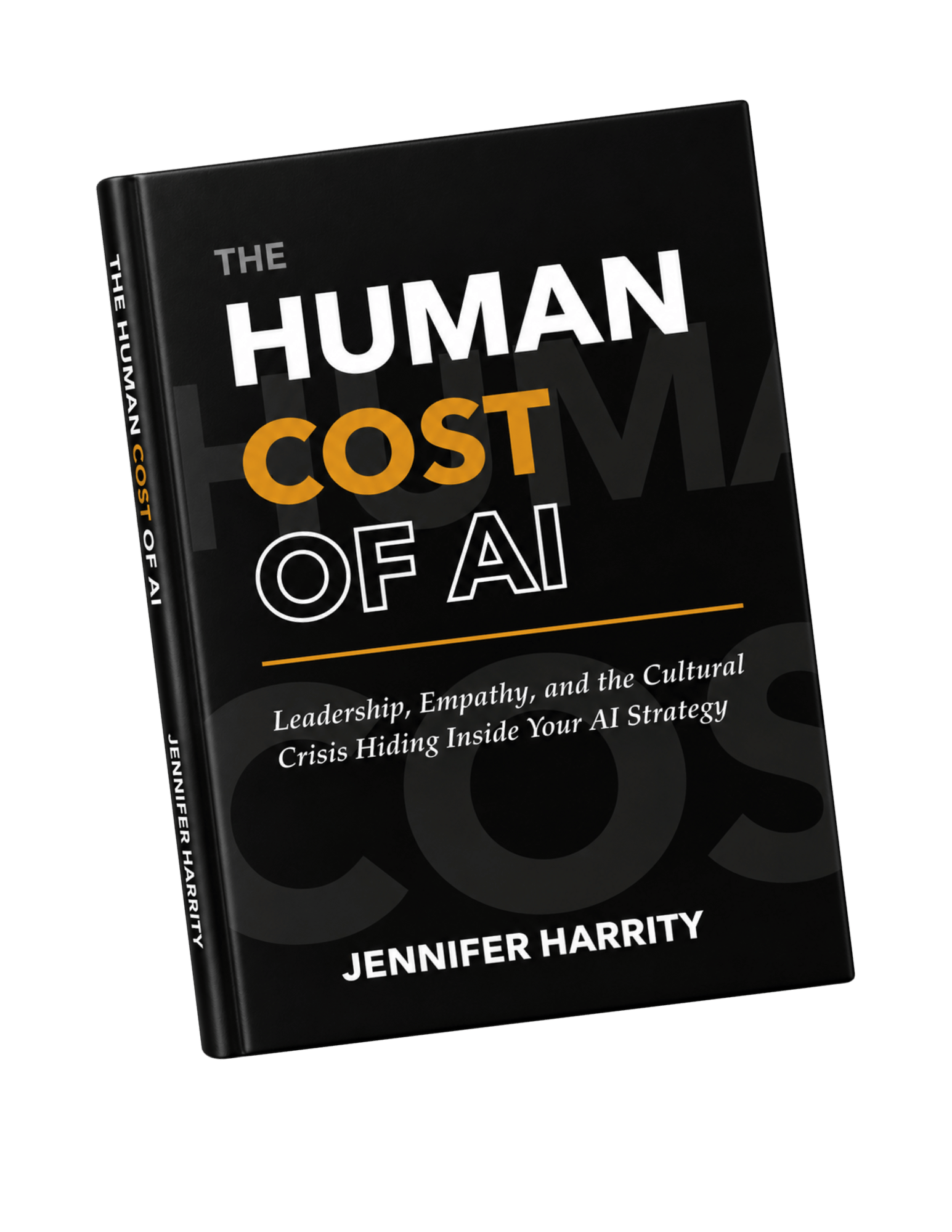
The Human Cost of AI
The question isn’t if your organization will use AI, but what kind of organization you’ll become while doing it.
Companies are investing billions in artificial intelligence, promising greater productivity, faster decisions, and more efficient organizations. Yet inside the workplaces where these strategies are being implemented, employees are reporting heavier workloads, managers are struggling to answer questions they were never prepared for, and leaders are wondering why adoption isn’t matching the investment.
The problem may not be the technology.
It may be the way we’re leading people through it.
In The Human Cost of AI: Leadership, Empathy, and the Cultural Crisis Hiding Inside Your AI Strategy, Jennifer Harrity examines the part of AI transformation that implementation plans too often overlook: the human experience.
Employees are not simply “resistant to change.” They are asking reasonable questions. Will my job still exist? Am I expected to become dramatically more productive because I now have AI? Is the company actually telling me what it knows? What happens if the technology changes my role faster than I can adapt to it?
Too often, leaders respond with polished talking points when what people really need is an honest conversation.
Sometimes the most credible thing a leader can say is, “I don’t know yet.”
Drawing on research from leading business, academic, and workforce institutions, real-world organizational examples, and more than 25 years working across operations, communications, governance, and transformational change, Harrity makes the case that the greatest risks of AI implementation are not only technical or financial. They are cultural.
And they are preventable.
The Human Cost of AI gives leaders and employees practical ways to navigate AI-driven change differently, including:
How to communicate about AI when the answers are still evolving
Why traditional employee surveys may be asking the wrong questions, and what to ask instead
Which human and cultural measures belong on your AI implementation scorecard
How managers can lead teams through uncertainty without pretending to have certainty
How organizations can address employee anxiety without dismissing legitimate concerns as resistance
What leaders can do to build the trust required for genuine AI adoption
How employees and managers can better understand, and articulate, the human consequences they are experiencing
This is not an argument against AI.
It is an argument for implementing it better.
Because an AI strategy can hit every technology milestone, stay on budget, and still leave an organization weaker than it was before.
The leaders who succeed in this era will not be the ones who simply deploy AI fastest. They will be the ones who understand that adoption depends on trust, that empathy is a leadership capability rather than a soft skill, and that employees are not an obstacle standing between the organization and transformation.
They are the people transformation has to work for.
Whether you are a CHRO navigating workforce consequences, an executive responsible for AI strategy, a manager caught between corporate directives and a worried team, or an employee trying to make sense of what is happening around you, The Human Cost of AI offers something increasingly rare in the conversation about artificial intelligence:
A way to talk honestly about what this moment is asking of human being, and practical guidance for doing better.